
Why People Feel They Have "Lost The Future" And How a Leadership Futurist Keynote Speaker Can Help Them Find It Again

Updated: Jan 23
Why Event Planners Are Booking Futurist Keynote Speakers in 2026
If you're planning a conference, leadership summit, or corporate event in 2026, you've likely noticed something troubling: even your most engaged attendees seem psychologically stuck. They're showing up, but they're not always leaning in to the conference or leaving the event feeling more positive, clear, and committed.
As an event planner or conference organizer, you need more than another trend-focused speaker. You need a futurist keynote speaker who can help your audience reconnect with possibility, agency, and purpose in an age of relentless disruption.
But there are many different kinds of futurists—moren here on what a futurist is—and some may leave your audience more confused rather than more coherent, and more hopeless rather than more optimistic.
The Hidden Crisis Your Conference Attendees Are Facing: "Losing the Future"
Across boardroom retreats, industry conferences, team awaydays, and leadership offsites, a pattern is emerging that is rarely understood or even discussed, yet shapes everything: "We can't see or sense the future anymore."
This isn't hyperbole. Dr. Steve Himmelstein, a New York-based clinical psychologist, reports that many professionals have literally "lost the future." They struggle to imagine anything ahead that feels coherent, workable, or worth moving toward.
It's a psychological response to the sustained "polycrisis": overlapping and interdependent economic, technological, ecological, and social disruptions that overwhelm our capacity to make sense of anything much, including time itself.
Relentless, ruthless, and rapid change is so intense, so confusing, and so chronic that most people simply cannot cope; so their sense-making capacities shut down and they hunker down, hoping it will pass.
But it won't. It will just get more. Extra.
This means most employees and attendees are likely:
Executing tasks but losing strategic orientation
Attending sessions but struggling to apply insights
Networking actively but feeling internally stalled
Taking notes, but unable to envision innovation
For event planners, this creates a critical question: How do you design conferences that don't just inform and motivate, but actually restore people's ability to feel, imagine, and build a better future?
Two Outdated Futurist Speaker Types To Avoid
For decades, conference futurism has been dominated by two modes, which I see as both increasingly unfit for 2026 audiences:
1. Techno-Optimistic Fantasies
Exponential AI curves are presented as inevitable
Frictionless abundance narratives
Zero acknowledgment of real struggles, like the impact of AI on white-collar jobs
Result: False hope and/or rising skepticism
2. Collapse-Heavy Doom Narratives
Overwhelming catalogs of risks and disruptions
Fear-amplification without pathways forward
Helplessness disguised as "realism"
Result: Event disengagement and post-event depression
Both approaches bypass attendees' lived experience. Neither helps conference participants re-enter the future as active participants. And neither delivers the ROI needed: engaged attendees who leave energized, equipped, and ready to adapt to the next curveball that comes at them.
What Makes an Effective Futurist Keynote Speaker for Events & Conferences in 2026
The most effective futurist keynote speakers for corporate events now practice what I call optimistic equanimity, a framework that:
✓ Acknowledges pain without amplifying despair
✓ Names uncertainty without creating paralysis
✓ Offers pathways without false promises
✓ Restores agency without toxic positivity
As I write in my forthcoming book, Speak Electric | Lead Magnetic:
"In our crisis-hit world, hope is in short supply even as it is more important than ever. We must speak truthfully about the scale of challenges while also painting walkable pathways toward possibility and progress. We must be real, without getting lost in despair; inspiring, without being naive."
For conference organizers, this means: Your futurist speaker shouldn't just forecast trends. They should restore your audience's psychological capacity to engage with those trends and unlock a grounded yet optimistic vision for a future they can see themselves in. I call this leadership futurism.
This is why effective futurist keynotes don't bypass emotion. They name the pain. They acknowledge what's stuck. They allow conference audiences to metabolize intensity rather than dissociate from it.
But they also refuse despair.
Your attendees don't come to conferences to be plunged into another collapse narrative. They already live inside those. What they crave isthe possibility that feels do-able, at a stretch.
Hope, in this sense, is not a feeling. It's a practice your event can activate.
What Happens When You Book the Right Futurist Keynote Speaker: How a Leadership Futurist Transforms Your Conference Experience
Before the Keynote: Your attendees feel change fatigue, are overwhelmed by disruption, are uncertain about their organization's future, and are skeptical of transformation initiatives. More acutely, they struggle to see a future past AI layoffs, tariff turbulence, and endless uncertainty.
During the Keynote: A skilled futurist keynote speaker will:
Name the unspoken anxiety in the room (giving permission to be human)
Reframe disruption through neuroscience and psychology
Introduce adaptive tools that audiences can use immediately
Restore future orientation through grounded possibility
Build confidence in human capability alongside technology, what I call the LEADERSHIP-AI Synthesis
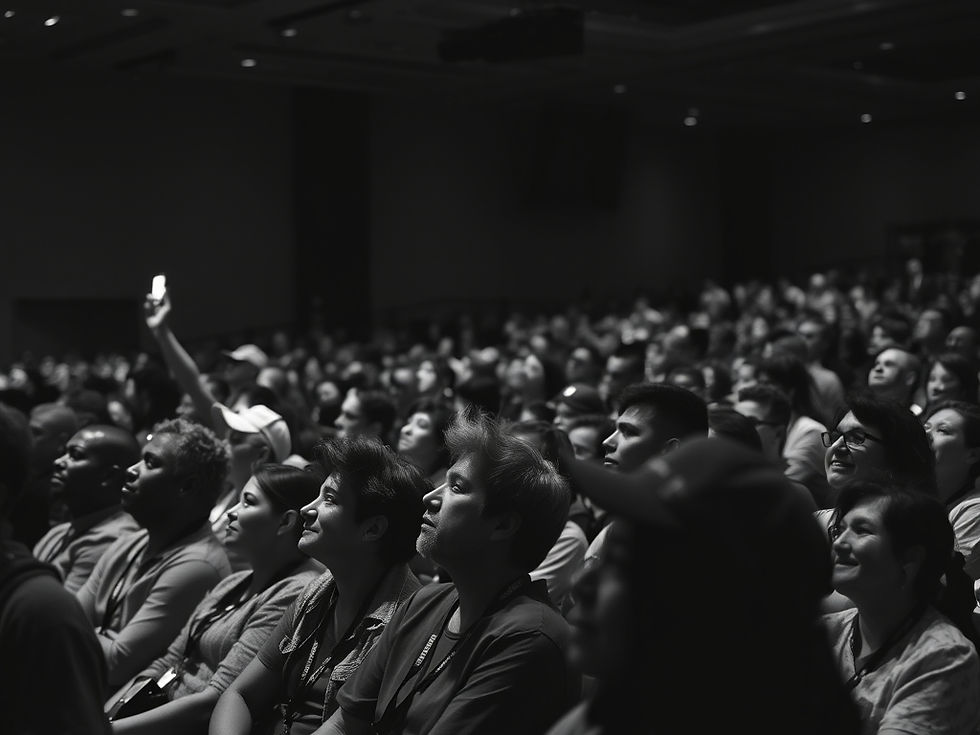
After the Keynote: Your attendees leave with renewed strategic clarity, practical frameworks for leading through uncertainty, restored capacity to imagine positive futures, and actionable next steps for their organizations.
Types of Events Perfect for a Futurist Keynote Speaker
✓ Annual Leadership Conferences: When executives need strategic clarity amid disruption
✓ Industry Association Events: When sectors face existential transformation
✓ Corporate Transformation Summits: When organizations are launching major change initiatives
✓ Executive Offsites & Retreats: When leadership teams need to reset strategic vision
✓ Innovation & Technology Conferences: When human factors must balance technological acceleration
✓ HR & People Strategy Forums: When employee engagement and meaning-making are critical
✓ Board-Level Strategy Sessions: When governance bodies need to make sense of complex futures
✓ Multi-Day Leadership Development Programs: When sustained learning requires restored hope and orientation
How to Choose the Right Futurist Keynote Speaker for Your Conference
When evaluating futurist speakers for your corporate event, look for evidence of:
✓ Customization Capability
Do they research your industry, audience, and specific challenges—or deliver generic content?
✓ Psychological Sophistication
Do they understand how to help audiences settle stressed-out nervous systems, be emotionally open, and engage in meaning-making?
✓ Practical Frameworks
Do they offer actionable tools attendees can implement immediately, or just inspiring stories?
✓ Balanced Realism
Do they avoid both toxic positivity and doom narratives?
✓ Engagement Design
Do they create interactive moments, or just lecture to an audience?
✓ Post-Event Resources
Do they provide materials that extend conference impact beyond the keynote?
✓ Proven Track Record
Have they delivered measurable results at similar events?
Let's Co-Design a Keynote That Transforms Your Event
If you're planning a conference, leadership summit, or corporate event where attendees need more than trend forecasts—where they need to rediscover their capacity to imagine, build, and lead in uncertain times—let's talk.
I bring:
25+ years of leadership, futurism, and transformation work
Fortune 500 experience across industries
Neuroscience-led methodology (BTX®) proven at scale
Customized content designed for your specific audience
Practical frameworks attendees can implement immediately
Conference planners consistently report:
Higher post-event engagement scores
Increased content application rates
Renewed strategic momentum
Attendees who feel "unstuck" and re-energized
Your attendees don't need another speaker who tells them the future is uncertain.
They need a futurist who helps them become the kind of people who can navigate uncertainty with confidence, creativity, and grounded hope!
FAQs ON What A Futurist IS & what they CAN DO FOR You
Question: What does a futurist keynote speaker actually do?
Answer: A futurist keynote speaker helps audiences make sense of complex change by offering grounded frameworks, human-centered insights, and practical ways to navigate uncertainty. Rather than predicting trends, leadership futurists restore orientation, agency, and confidence so people can actively shape the future.
Question: How can a futurist help employees, not just executives?
Answer: A futurist with facilitation and leadership development skills can help employees reconnect with a future they can imagine themselves participating in. This includes naming uncertainty, reducing fear, restoring meaning, and showing how everyday roles contribute to larger transformation journeys.
Question: Why do people feel like they have “lost the future” at work?
Answer: In periods of sustained disruption, people can lose the psychological capacity to imagine positive or workable futures. This often leads to anxiety, disengagement, and resistance to change. A talented and emotionally intelligent futurist keynote speaker helps rebuild future orientation through clarity, coherence, and grounded hope.
Question: Is futurism just about technology and AI, or about geopolitical risks as well?
Answer: No. While AI and digital technologies matter, modern futurism should also be about human capability and transformative adaptability. It focuses on how leaders and organizations adapt psychologically, culturally, and ethically in a rapidly changing world.
Question: What makes a great futurist keynote speaker today?
Answer: The best futurist keynote speakers balance realism with hope. They avoid both doom-mongering and naïve optimism, acknowledge pain and complexity, and offer regenerative visions with practical, actionable next steps.
Question: What is a leadership futurist?
Answer: Unlike traditional futurists who focus on trends, technologies, or distant scenarios, a leadership futurist works at the intersection of psychology, systems change, leadership, and strategy. The role is to help leaders and employees make sense of disruption, stabilize themselves emotionally and cognitively, and reconnect with a future they can imagine participating in.
Question: How is a leadership futurist different from a strategy consultant or technologist?
Answer: Strategy consultants typically focus on market analysis, competitive positioning, and execution plans. Technologists and AI experts concentrate on tools, platforms, and technical capabilities. All of this work is valuable, but it often assumes that people are already psychologically ready to absorb change and act on it.
A leadership futurist addresses the missing layer: human readiness and transformative adaptability. When organizations face sustained disruption, many leaders and employees lose orientation, confidence, and the ability to imagine a future they want to participate in. A leadership futurist helps restore that capacity by working at the intersection of psychology, leadership, systems change, and culture. The focus is on sense-making, meaning, emotional regulation, and adaptive capacity, so strategy and technology can be developed appropriately and executed effectively.


Comments